


Road & Rail Nameplates
Nameplates for road and rail environments must withstand extreme amounts of wear, as well as weather, salt, and a cocktail of chemicals that will destroy most types of signage. The challenges for railway track nameplates are slightly different to pavement plaques and roadway nameplates, but we would advise you to read through the requirements for all types. It won’t take long, and your project could well have a mix of these requirements.
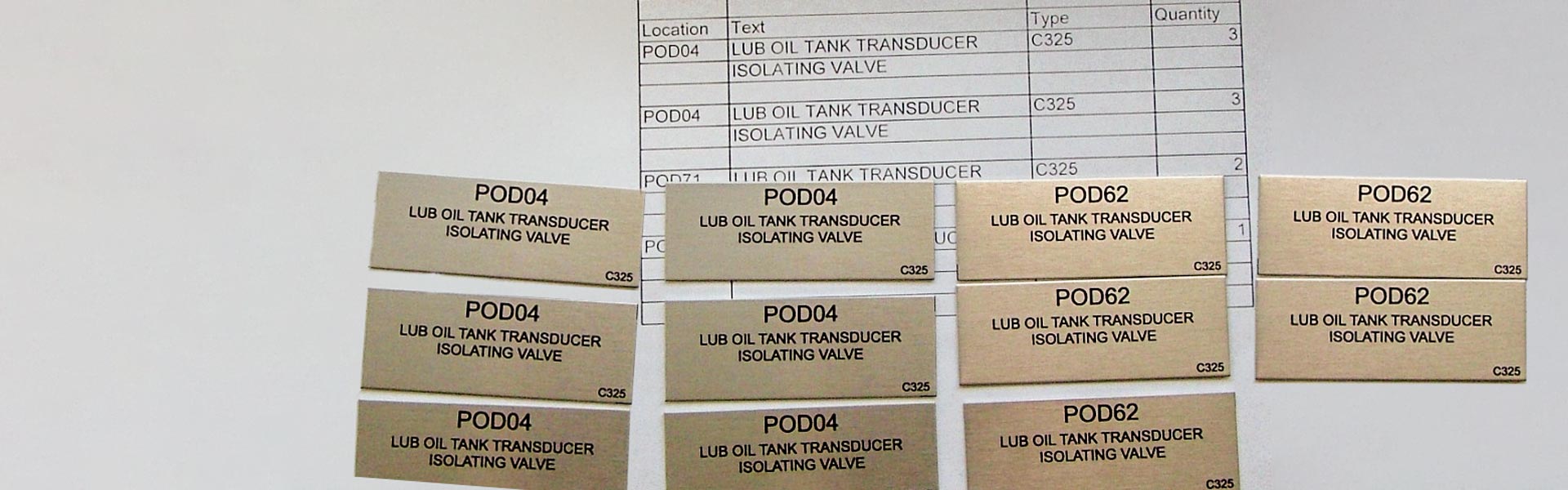
Railway nameplates such as balise ID plates, signalling nameplates, or chainage plates that sit near or between the rails, must withstand harsh environmental conditions. Important safety and identification information must be clearly and permanently displayed. It must not fade, peel, or wear away due to friction or UV exposure. They must have excellent chemical resistance, and withstand exposure to diesel oils, grease, brake dust, and aggressive track maintenance chemical fluids. For fire and tunnel safety, they must also conform to LSZH (Low Smoke Zero Halogen) standards.
Our specially developed anoprinted aluminium meets all these requirements, and is far superior to other types of anodic printing. Surface prints, laminates, vinyls, and engraved plastics, simply will not survive in this type of environment and should not be used.
Our anoprinted aluminium uses a permanent black pigment inside a much thicker anodised surface than other types of anodic printing. It therefore withstands much higher levels of wear and abrasion, and also remains readable after exposure to fire. It is unaffected by all chemicals used in the trackside environment. The rail environment is filled with a highly complex mix of safety-critical infrastructure, all of which must be visibly identifiable at all times. Maintenance and inspection personnel must be able to read trackside identification plates such as sleeper asset tags, signalling asset markers, and rail network identity plates.
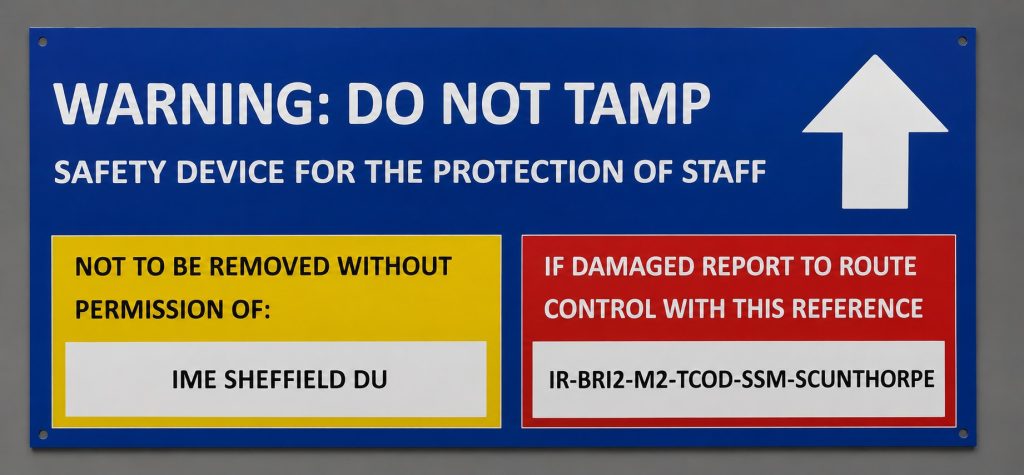
Colours can be used, but be aware that like all printed products, colours will fade if exposed to sunlight. All important information should be in black, and the black we use will never fade. We have developed some strong colours, such as are used in these TCOD plates which we designed for the UK rail network, and are approved for use by Network Rail.
Etched 316 grade stainless steel can sometimes be appropriate for use in the rail environment, such as when part of stainless steel enclosures. If in doubt, send us details of your project and we can advise the best solution for you.
Identification and information plates used on the ground must withstand similar challenges, but also a lot more physical wear, depending on where they are located. Replacement of nameplates because they have failed is expensive, so it is important to use the correct specification.
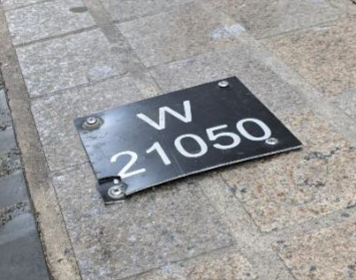
Plaques set into pavements may have to withstand wear from high levels of foot traffic, and also must not present a slip hazard. Parking space identification plates, or road surface markers used near kerbs, will only have to endure light amounts of wear from traffic, and our anoprinted aluminium will provide a solution for clear visibility with black graphics against an almost white background. In low traffic environments, this is often the best specification for ground mounted nameplates and kerb plates.
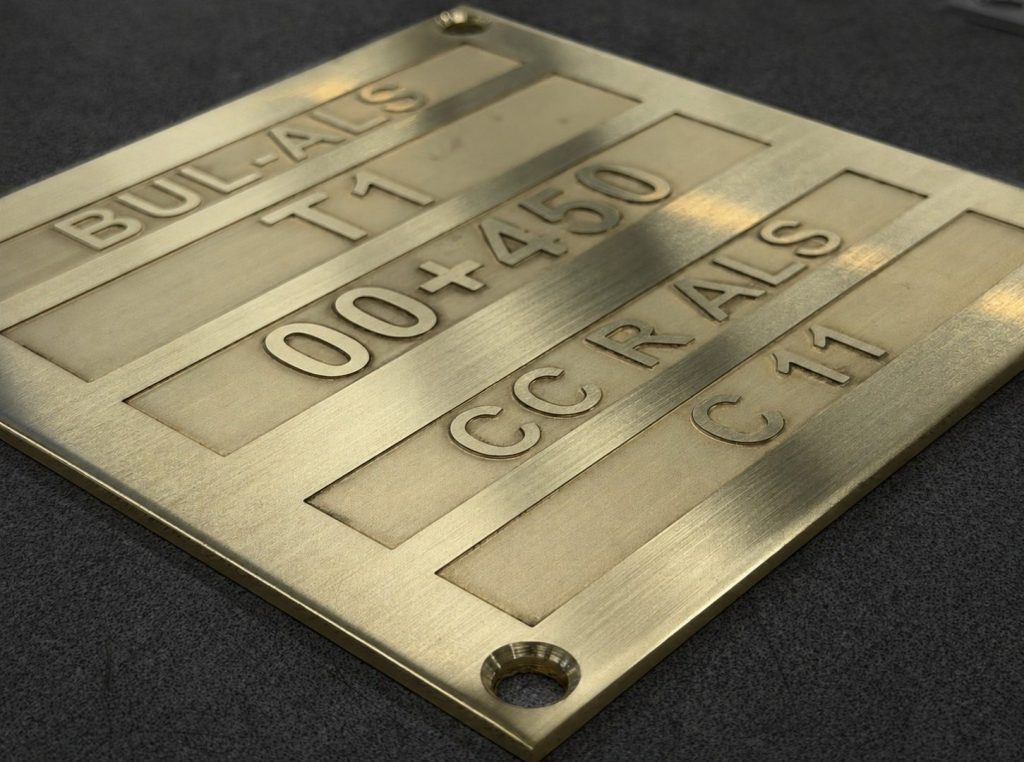
No type of nameplate will withstand the amounts of wear found on the main traffic areas of carriageways where even the road surface itself wears out, and nameplates should not be located in such areas, but in reduced traffic environments, heavy duty roadway nameplates made from brass can be used. This is often a good solution for pavement nameplates. Typically using 3mm thick brass, the information is left as raised detail and the background etched away. No paint fill is used as this would be destroyed. Legibility is achieved because the higher surface is abraded while the background oxidises, creating a patina, which along with the three-dimensional surface creates visibility.
Manhole cover identification plates often have to endure similar conditions to road or pavement plates. These are typically fixed to the manhole covers but are occasionally fixed adjacent to them on the ground surface. Both anoprinted aluminium and deep etched brass could be the best solution. Please contact us with your requirements and we can advise the best way to proceed.
If you are unsure which option will be most appropriate for your project, please contact us to discuss your requirements. Anoprinted aluminium generally provides the best visibility, while deep etched brass withstands the most wear, but occasionally something more bespoke may be required.
Fixing for most rail environments is by screws into sleepers or specific areas of equipment. Fixing onto road and pavement surfaces should always be a combination of mechanical fixing such as screws, and an adhesive/sealant. The adhesive will keep the plates stable and prevent movement which could eventually cause distortion, and will also seal the gap between the nameplate and the surface, preventing the ingress of water and dirt which could eventually lead to distortion from frost action.
A data sheet for anoprinted aluminium can be found on Page 5 of our Digital Anoprinting Guide.